

Best Espresso Machines for Small Offices and Home Bars on a Budget for Spring Entertaining
🏆 Top Picks at a Glance
 #1
#1
Best Overall
atatix Espresso Machine with Milk Frother, 20 Bar Pressure Espresso Maker, with 44OZ Removable Tank, Compact Stainless Steel Coffee Machine for Home, Office, Latte, Cappuccino, Macchiato, Silver
Check price on Amazon
Check Price → #2
#2
Runner Up
SUNVIVI 20 Bar Espresso Machine for Home and Office, 3-in-1 Iced Coffee Maker with Milk Frother, Espresso Shot & Iced Coffee, LED Touchscreen, 52OZ Removable Water Tank, Professional Coffee Brewing
$84.99
Check Price →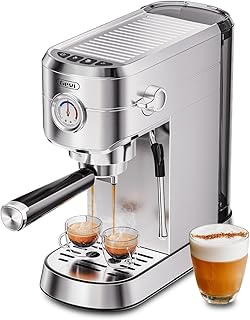 #3
#3
Best Value
Gevi Commercial Espresso and Coffee Makers, Professional 20 Bar Espresso Maker with Milk Frother, Stainless Steel Expresso Coffee Machines for Home, Compact Cappuccino Machine, Great Gift
Check price on Amazon
Check Price →Our Top Picks
Affiliate disclosure: if you buy through these links, we may earn a commission at no extra cost to you.
Factors to Consider
Grind consistency and dosing
⚡ Quick Answer
Grind uniformity is the single biggest determinant of shot quality — inconsistent particle size creates uneven extraction, sour edges, or hollow sweetness. For a small office or home bar I recommend a stepless or micro‑adjustable burr grinder and weighing doses by weight; machines with built‑in grinders (for example the Breville Barista Express Impress) remove one variable by pairing grind and dose to the grouphead. If you plan to share the machine, choose a grinder with at least 40–60 grind steps so colleagues can dial in quickly without upsetting the rest of the shots.
Table of Contents
Temperature stability and extraction control
Temperature consistency directly affects sweetness, body, and crema — a stable brew temp yields more balanced, repeatable shots. Models like the Breville Bambino Plus are noted for excellent temperature consistency, which helps beginners get high‑quality extractions without constant tweaking. Look for PID control or stable boiler design (thermal mass or heat‑exchange systems) if you want to push for more nuanced single‑origin shots.
Steam power and milk texture
Steam performance dictates the microfoam you can produce: commercial‑style texture needs sustained PSI and a powerful steam wand. For spring entertaining where lattes and cappuccinos are frequent, choose a machine with a wand that can create glossy, fine‑bubbled milk quickly — this preserves sweetness and improves mouthfeel. If you want automation for milk, the Breville Oracle Jet automates frothing, but for hands‑on control check pressure/boiler size specs to ensure rapid recovery between pitchers.
Build materials, ergonomics, and serviceability
Solid brass or stainless boilers, commercial‑style 58mm portafilters, and metal lever or spring handles improve thermal mass and extraction stability while standing up to office use. Budget machines like the Gaggia Classic Pro (roughly $451) trade some bells for a robust, serviceable platform that yields surprisingly complex shots when paired with a proper tamper. Prioritize replaceable parts and accessible service manuals if you expect heavy daily use.
Automation vs manual workflow and total value
Decide how much of the workflow you want automated: fully automated systems save time but cost more, while manual machines give control and better value per dollar. The Breville Barista Express Impress is beginner‑friendly with a built‑in grinder and tamping arm, while high‑end options like the Profitec Go (about $1,199) reward attention with deeper, more consistent flavor extraction. For small offices on a budget, weigh throughput, training time, and whether you need features like automatic dosing or tamping to keep lines moving during entertaining.
Frequently Asked Questions
Do I need a separate grinder, or are built‑in grinders good enough?
Built‑in grinders like the one in the Breville Barista Express Impress are fine for many home and small‑office setups because they simplify dosing and reduce countertop clutter. However, a high‑quality standalone burr grinder will generally give better grind consistency and more flexible adjustment for single‑origin tuning, which matters if you chase more nuanced extraction.
How important is temperature stability for espresso?
Extremely important — stable brew temperature tightens sweetness and balance in the cup. Machines noted for temperature consistency, such as the Breville Bambino Plus, make it much easier to pull high‑quality shots with minimal tinkering.
Can I get café‑quality shots on a budget machine?
Yes. New home machines have lowered the skill barrier for cafe‑quality drinks, and the Gaggia Classic Pro (around $451) demonstrates that a modest budget can still produce complex, satisfying shots when paired with a good grinder and technique. Expect to invest in a separate tamper and a decent grinder to extract the best results.
What’s the difference between manual and automatic machines for office use?
Manual machines give you granular control over dosing, tamp, and timing — ideal if you want to train baristas or fiddle with extractions. Automatics streamline consistency and speed; the Breville Oracle Jet automates grinding, dosing, tamping, and frothing, which is excellent for high throughput but comes at a higher price and less hands‑on control.
How important is steam power for milk drinks at gatherings?
Very important — steam power affects how quickly you can texture milk and how fine the microfoam will be. For entertaining, choose a machine with strong steam recovery and a wand that produces glossy, velvety milk so lattes pour with silky mouthfeel rather than large, soapy bubbles.
Do I need a tamper or does one come with the machine?
Some machines include a tamper or an automatic tamping arm — the Breville Barista Express Impress even integrates a tamping arm to simplify the workflow. Budget staples like the Gaggia Classic Pro typically require a separate tamper, and having a properly sized, flat tamper is essential for even extraction and crema development.
How often should I descale and maintain my machine?
Maintenance frequency depends on water hardness and usage, but a general rule is a light rinse/backflush weekly and a full descale or chemical clean every 1–3 months for regular home/office use. Regular cleaning preserves steam power, prevents channeling in the grouphead, and keeps flavors bright for spring entertaining.
Conclusion
For small offices and home bars on a budget, aim for a machine that balances grind control, temperature stability, and steam performance — those three factors deliver the most immediate improvement in cup quality. If you want the best mix of beginner‑friendly automation and value, the Breville Barista Express Impress is a strong pick; for tighter budgets the Gaggia Classic Pro delivers surprising complexity when paired with a good grinder, and the Profitec Go is worth considering if you can stretch to a $1,199 investment for top‑tier consistency.


